The Noncognitive Side of Teaching
EdTalk – given at the CA Teachers Summit 2015 on July 31st at Brandman University, Roseville, CA.
Good Afternoon Everyone,
Today I would like to talk to you about the growing value being placed on the noncognitive skills and abilities of our students. Changes in academic attitudes and behaviors, such the desire to learn or the willingness to think critically cannot be demanded from a student. Students must find a reason to learn, and that reason is very often the passion that you have for learning and your relationship with the students.
First, a little about how I came to be here today: I grew up on a small farm in Northern Florida (show map), the oldest of 4 boys. Neither of my parents had graduated from high school and college was a foreign word to my family. Although I had always worked in the fields for my family, my father apprenticed me when I was 12 years old to a local tobacco farmer. I also picked peaches, bell peppers, cabbage and much more. I eventually made it out of the fields and got a job as a meatcutter at an IGA grocery store. I gave every other paycheck to my parents, which wouldn’t have been too bad if my mom hadn’t always started crying right there in the store.
I was very fortunate that I had teachers who believed in what I could become. They encouraged me and helped me see a future that was foreign to me, a future that I could not connect with my life to that point. I had faith in them, so I sought out that future.
When Mr. Cooper, my math teacher, gave me a C on my report card (the first C I ever made), he told me that I could do better, and he expected me to do better, I believed him. And I did better. I graduated Valedictorian and I credit Mr. Cooper with helping get there.
When my instructor at City College told me that I would need a 98% on the Calculus final to get an A in the class, and that no one had ever gotten that on his final, Mr. Cooper was there with me when I my score came back as a 99%.
In 2013, I was nominated for Elk Grove District Teacher of the Year. I have never been the kind of person to desire the spotlight, but I felt that my school deserved some positive attention. After 8 months of interviews and classroom visitations, I received a call from the California Superintendent of Schools’ office. I had been selected as a California Teacher of the Year, and that I was chosen to represent California at the national level. Dozens of students gathered around me to celebrate. At that moment, seeing their joy and pride, I knew that I had done the right thing.
I teach at Florin High School where 100% of the students are on free lunch. We have 19 different primary languages at our school, and many of the students know the feel of poverty as I did. Many don’t see education as a path to a better life. So it is left up to the teachers to show them. Dewey and Friere and many others have said that the best learning takes place in the context of the life experiences of the students. With 19 different cultures at our school, trying to relate to the life experiences of our students is challenging at best. The relationships that our teachers develop help overcome the cultural differences of our students. For example, the advisor for the Indian club is Latino. And I was the advisor for the Muslim Club for two years. We very often step out of our comfort zone to learn about our students’ cultures and build relationships with them. This is even more imperative now that we have the Common Core State Standards.
After giving Common Core a try for the last couple of years, I think I have figured out how to teach it. I have this new magic wand here (don’t mind the duct tape). You see, the way I figure it is that if I have to teach Perseverance, grit, tenacity, abstract reasoning, critical thinking, and how to communicate with others, I might as well whip out a little magic for it. After all, how in the world am I going to get a student to persevere when they don’t want to. For that matter, what the heck is grit anyway?
Ladies and gentlemen, I am here today to tell you that there is no magic wand that will get students to reason abstractly or be tenacious.
During one of my evaluations as a student-teacher many years ago, my mentor said to me that my delivery of the content and the structure of my lessons were as good as he had ever seen, but I seem to be missing something… something he called “with-it-ness.” I was upset. What is “with-it-ness” and how did I miss learning it?
Over the years, I have noticed the same absence of “with-it-ness” with the student-teachers I have worked with. That “with-it-ness” is the relationship side of teaching. The student-teachers were all very knowledgeable in math content, but when it came to establishing relationships with students, most seemed very inexperienced.
I believe that it has always been critical for teachers to learn to establish relationships early on in their careers, but now it their jobs depend on it. Two aspects of learning that are finally getting more attention are the non-cognitive skills and the social-emotional skills. Both are heavily dependent on student-teacher relationships and administrators are trying to find ways to measure them.
What I mean by non-cognitive and social-emotional skills are the things that are not content knowledge or core academic skills, but matters for academic success.
- Professionalism
- Grit
- Motivation
- Persistence
- Tenacity
- Confidence
In order for us, as teachers, to change and foster these skills, we must gain the trust and respect of the students.
Some teachers say that they have learned a lot from instructors who were cold and uncaring, but great in their content knowledge. Would those instructors have been able to inspire confidence and persistence in a student that did not have it? Did those instructors reach every student?
When the students come to my classroom for the first time, I don’t expect their trust or demand the respect. I have a wooden stool in the front of my classroom. I pull that stool closer to them and I tell them that “For the next 180 or so days (and perhaps much longer), I will be like a father to you. I will give you every bit of me that I possibly can, but I will expect the same from you. I hope that over the next few weeks that you will recognize how much I care for each and every one of you.”
And then I live up to it. There is no “almost” in fulfilling a promise like that. You do it or don’t say it. If a student needs me, then I am there. No matter how lousy my day is going, I am honestly glad to see them when they walk through the door. I have water and granola bars when they are hungry. When RT is late, which is often, I allow them to eat breakfast in my room.
I sponsor one or two Seniors every year for their Senior activities. I help pay for their AP exams, college applications, calculators and computers. My wife has sewn buttons on sweaters and taught students how to cook for themselves and I have fixed up bicycles for them to ride.
A few years ago, one of my Seniors told me that she was going to have surgery in the Fall and that her mom was unemployed. She was not going to be able to attend any of the Senior year events. I offered to sponsor her for the Senior picnic, the Senior ball and graduation. It did not cost as much as you may think. Well her surgery did not go well and she missed over a month of school. I went to all of her teachers and worked out a schedule to help her stay up on her work. She recovered, passed her classes, and had a wonderful time at Senior ball. On the last day of school, after all the students had gone home, the student and her mom walked into my room with dish after dish of cookies and desserts. The student then said that after the surgery had gone wrong, she had considered suicide. She said that my unconditional caring for her had helped her to come back and enjoy life again. We were all mopping the tears out of our eyes by that time.
A teacher does not have to go to those extremes to establish relationships. If you try too hard, which I often see in new teachers, it seems fake and the students recognize it immediately.
Subtle signs that you care are a sincere greeting at the door, stopping by their desks to ask how their day is going, a Hershey’s Hug (DON’T GIVE KISSES) when it’s obvious they are having a bad day. Sometimes a gentle pat on the shoulder as you walk by. Each teacher has a unique personality. Be sincere and let students know you care in your own way.
And if you are comfortable with telling jokes to your students, do it. I was told when I got my credential not to smile until December. But students need to see you smile. They need to see you laugh.
I recently told my Algebra 1 class about an incident in the attendance office. A young man came to school late and asked the attendance clerk, Ms. Rae, for a pass. She looked up and said “Young man, is that a lizard on your shoulder?” And he said “No Ma’am, it’s a NEWT and his name is Tiny.” Ms. Rae asked “Why is his name Tiny?” and the student said “Because he is my newt (minute)!”
Well, not a single person in the whole Algebra 1 class laughed. Not one. So I said “Do you get it? My newt… minute?” Still nothing. So I walked over to the board and I wrote MY NEWT and MINUTE. I said “My newt and minute.” One student said “Mr. Smith, that spells minute.” I said it can also be pronounced minute. Meaning tiny. They said “Why didn’t you tell us in the first place?” I said “Forget it, let’s go on with the lesson.” About then, one student named Aleyna, who sat near me, leaned over and said “Tell it to us again, Mr. Smith, it will be funny this time.”
The value of those relationships that you develop is going to grow significantly over the next few years. Studies are emerging that the grades that students receive in your classes are greater indicators of success than single event assessments, like AP exams and SAT’s. (Kurlaender, Reardon, & Jackson, 2008; Neild & Balfanz, 2001; Zau & Betts, 2008)
A 2009 study by Bowen, Chingos, and McPherson revealed that high school grades were a much better predictor of college graduation that ACT’s or SAT’s largely due to the fact that high school grades tended to capture those noncognitive skills that are so important for success later in life.
In the near future we’ll see a greater acceptance of noncognitive education among administrators and politicians. For now, we must help develop ways to measure the noncognitive growth of our students and ways to help new teachers learn to feel comfortable enough to develop sincere student-teacher relationships.
I’m about out of time, so I’d like to highlight what I’ve presented today.
- Student-teacher relationships are not learned in a credential program, but are essential early in a teacher’s career.
- Student-teacher relationships open the door to change in noncognitive skills and abilities by creating a safe and interesting learning environment.
- Common Core State Standards emphasize noncognitive skills particularly in the areas of persistence, communication, and critical thinking.
- Research is adding weight to the value of grades and GPA’s versus single event testing because of the noncognitive skills that grades often measure.
This presentation and Powerpoint is available at CATeach2014.com.
Thank you for being such a wonderful group to speak to today.
References
Bowen, W.G., Chingos, M.M., and McPherson, M.S. (2009) Crossing the finish line: Completing college at America’s public universities. Princeton, NJ: Princeton University Press.
Farrington, C. A., Roderick, M., Allensworth, E., Nagaoka, J., Keyes, T. S., Johnson, D. W., & Beechum, N. O. (2012). Teaching Adolescents to Become Learners: The Role of Noncognitive Factors in Shaping School Performance–A Critical Literature Review. Consortium on Chicago School Research. 1313 East 60th Street, Chicago, IL 60637.
Pizza, Burgers and Technology Delivered Fresh to My Classroom
During an after-school study session this week for AP exams, I wondered aloud what my blog topic would be. From a spot somewhere among a pizza-eating group of Seniors, a voice rang out, “Pizza!”
“Pizza would be great,” I shouted back, “but I need to focus on the technological side of educating you.” But then again, maybe the student was right. There was classroom technology in pizza. The new online ordering systems for pizza are ripe for introducing functions and linearity to students. So what if the result is a bunch of orders cancelled at the last possible moment.
Most pizza places now have online ordering, many with the option of building your own custom pizza. Extra ingredients cost extra (duh!), but increasing at a constant rate for most added ingredients. Students can quickly see that a model can be created to predict the final cost of a pizza with a particular amount of extra items.

Ten extras are the limit. It won’t cook completely after that. (Sounds like a math problem to me.)
More recently added in our region is a fast-food hamburger restaurant that delivers. I thought I had died and gone to heaven when I heard that you can order hamburgers and French fries online and have them delivered to your door. Isn’t this world amazing, or what? The website of the restaurant of “the king who shall not be named” allows customers to build their own burgers and chicken sandwiches.
While the customer builds the meal, the price is adjusted accordingly. Plotting this data on a coordinate plane allows students to create a scatterplot of burger prices based on a variety of differently priced extras. Using this data, students can construct a linear regression line through the scatterplot to estimate the price of a burger with a certain amount of extras. Other task-based problems involving this data may include a comparison of retail and profit models as well as a discussion of outliers and influential points.
The current influx of computers in the classroom provides an opportunity for students to explore actual websites to construct mathematical models of common tasks, like ordering pizza or burgers online. These tasks align with the Common Core State Standards and Standards for Mathematical Practice. Lesson designs for this type of activity include web searches, scavenger hunts, and WebQuest templates. The range of difficulty could be adjusted to fit a wide range of grade and mathematical skill levels.
Another benefit of using pizza and burger websites to develop functions and linear regression models is the quality of the graphics. Modeling software using “pizza building” functions have been around for a while, but the vividness and realism of current websites makes adding all the extras even more fun.
The SBAC Maiden Voyage
Today we concluded the maiden voyage of the CAASPP (SBAC) exam at our school. My hope was to monitor all aspects of the assessment (math and language arts) and report my observations and suggestions back to this blog. Unfortunately, food poisoning took hold of me the day before the math portion of the assessment and kept me away for two days. Here’s how the story unfolded.
We tested in our home rooms. The students in my home room have been with me for three years. Steven, who is now 6’4″, grew from a whopping 6’3″ as a freshman. Okay he was a tall freshman, but he looks more mature, too. Jacob, who had a young-looking face for his freshman and sophomore years, now has a full beard. Better than I could grow, too.
The thing is, I know these students, so my absence created a different atmosphere that could have had an impact on their comfort and motivation on this assessment. The other teacher that was my assistant had to take full charge of administering the exam. While both of us were trained at the same meeting, he was not prepared to be the sole administer. He is a great teacher and that made a difference in what could have been a chaotic event. Even when the wireless went out in my classroom, he smoothly moved all of the students to the pre-designated alternate room and carried on with the test.
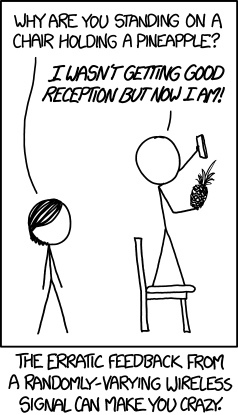
When the wireless went out during the SBAC exam.
Most students commented that the math portion of the test was easier than expected, although some confusion occurred over the use of scratch paper and several teachers did not let students use scratch paper at all. The test allowed the use of scratch paper and students commented that it would have been very difficult to solve many of the problems without scratch paper. The only other significant challenge was knowing how to use both versions of the scientific calculator on the test. The drop down version was slightly different than the version at the bottom of the screen.
The language arts portion of the exam went much more smoothly, although as an administrator I noticed several students suddenly go through 10 or 15 questions. I highly suspect that the passages that should have been read, were not.
As an inaugural assessment, I believe that it was a success. Students seemed to be engaged and comfortable with the medium used for testing. Perfection the first time around rarely happens. Now let’s wait for the results to arrive so the analysis can begin. That’s when the adjustments will really start to occur.
The Good, The Bad, and The SBAC
The Good
It’s high noon and the roll out of the SBAC online testing is tomorrow. Administrators have organized the school into areas of testing and non-testing, with our Seniors presenting their Senior Projects in the non-testing areas. Alternative classrooms have been designated in the event that wireless should fail (as it did in my wing this week). Each proctor has a assistant who has received training in conducting the exam and what drink we want from Starbucks.
The first test is the computer adaptive math test, and the allotted time for administering it is around two and a half hours. The test is untimed, so if students don’t finish in two and a half hours, well…we’ll cross that bridge when we get there. Actually, there is supposed to be a designated location where students can go and complete their tests, but that means they have to log off and log back on. Students will have to stop at a saved point to avoid re-doing problems. This move could result in a number of interesting events, but I’ll save those for the next blog.
The Bad
Day 2 is beginning to cause consternation among the faculty now that we have seen the activity that is the basis of the task questions. Most of us did not realize that half of the math portion of the assessment would be task-based.
Over 25% of Florin High School’s students are EL, with many more having been previously classified as EL. Typically our students struggle more with word-based problems and applications. Students and teachers don’t make excuses for doing poorly on those problems. There is just a steeper hill to climb to get to the answer.
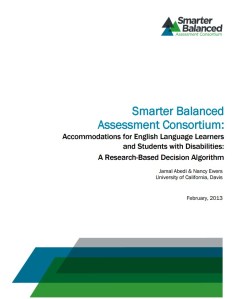
A list of accepted accommodations.
The SBAC
The Smarter Balanced Assessment Consortium has established “accommodations” for English Language Learners and Students with Disabilities, but even with pre-programmed accommodations, Day 2 will be challenging for those with the EL designation and for those without it. The data collected on our students for this assessment will certainly have a significant impact on future instruction. Reading and writing across the curriculum has long been a focus, but a greater emphasis on reading mathematical material will surely emerge.
But for now, we will breathe deep, get a good night’s sleep, and be ready when Starbucks opens tomorrow. Tune in next week for the Good, the Bad, and the Ugly of the SBAC assessments.
Countdown to SBAC (or whatever it’s being called today)
While not quite as exciting as Season 5 of Game of Thrones, the saga of spotty wifi and dead batteries rampages on.
We are nearing the maiden voyage of online testing next week with some cracks beginning to appear in hull of our ship. The Math department was given an activity just a couple of days ago, and we were told that all 11th graders needed to be familiar with it in order to understand part of the Smarter Balanced Assessment. As in most places, our 11th grade students are spread over several levels of math. In order to present it to them, we either needed an emergency homeroom session (which we weren’t going to get) or every math teacher had to give up a day to teach the activity. Bribing my colleagues with my famous carnitas seemed to work, and we press on.
I have been working with many of Florin High School’s math teachers in training our 11th graders on the Smarter Balanced Assessment. First, I emailed them with links to the test prep site, the I rolled the Chromebook cart to their rooms to help get their students online. Some of the Chromebook batteries were low because they hadn’t been recharged properly. We remedied that situation easily, however. Next, I told the students to log on.
Weeks ago, I was given administrative permission to help students change their forgotten passwords, so the login process usually goes smoothly. Except today, of course.
After quickly and carefully handing out the Chromebooks to the students, one hand after another shot up. Something was wrong. Really wrong. After checking all the systems we determined that the wifi in the teacher’s room was not working. Strange. It had been working all year. So, we moved the students and their computers to my room. It always has wifi. Except today.
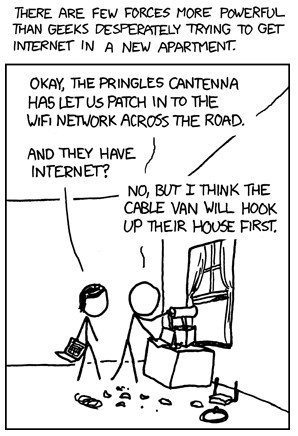
I think we can make this work for 430 students. Give me another Pringles can.
http://imgs.xkcd.com/comics/moving.png
The administrator I called seemed to not believe me. The wifi couldn’t be out in a whole wing. That wing was designated to be part of the test-administering section of classrooms. I asked if there was a reset switch for the wifi system. He didn’t know. Our tech person was offsite, so no help was coming from there. I asked what would happen if the wifi went out during the test. He wasn’t sure. Would the students be able to log back in at another location in the school? He wasn’t sure. If they pressed “save” often, would it protect them in case of a wifi outage? He wasn’t sure. I asked what the contingency plans were in case of a widespread outage. There wasn’t one… yet. Now it seemed like a good idea. You bet.
Tune in next week to see how our trusty heroes prepare for the epic online challenge. You’d better be among the first to read, or there may be spoilers (and not just from Game of Thrones!). Thank you for reading this blog. Have a great week!
The Trouble With Evaluating Technology-based Assignments
Near the end of his senior year in high school, the young man met with his principal and one of his teachers. He felt that the “B” he had received on his report card was unfair. The class was Journalism and he had done more than anyone in class. He had completed his part of the Sports section for his yearbook, finished two other parts for other students and took over for the yearbook photographer who dropped the class. The students whose sections he had completed received “A’s” in the class, but he received a “B”. When the teacher defended her actions, she told the principal that she expected more out of him than the other students.
That day nearly cost me my chance to go to college. Since then I have been very careful to ensure that my expectations are clear to my students. Rubrics are a necessity. I want to challenge all students, but as any teacher knows, some students will find your assignments more difficult than others.
Technology-based assignments are adding a whole new dimension into establishing rubrics and expectations of students. Recently, I gave an online research project to my AP Statistics classes. The criteria for the research and reporting was clearly defined in a rubric, but I left open the method of displaying the report. I gave the option of Prezi, PowToons, PowerPoint, iMovie or any other technology-based report.

PowToon Brings Awesomeness to Your Presentation
The result was a huge array of presentations, some flashy, some not. I found it very difficult to separate the expectations that I had on my rubric from the quality of the presentation. Could all of the project’s requirements be displayed in a simple Powerpoint? Yes. Did I want to give a higher score to the flashy presentations like the YouTube videos or PowToon recordings? Yes, again. But I didn’t.
My students are arranged by groups, and I knew that Group 2 would attempt a flashy presentation. The four students were very tech savvy and would find it easy to create an eye-popping presentation. Group 6, on the other hand, consisted of four students, of whom only one had internet at home. Group 6 worked on the project after school in the computer lab and the learning curve for the presentation was significantly higher for each of them.
As we progress to more technology-based lessons, teachers must be aware of the 21st century skills that our students have mastered. What part of the students’ grades is from their technological knowledge, and is that part of the rubric? Are teachers knowledgeable enough to set standards for technology-based assignments?
There is a growing number of resources that assess and support teachers in our ability to evaluate not only the content knowledge of our students, but the ability to communicate that knowledge through technology.
A couple of websites that I have found helpful are EdTechTeacher.org (http://edtechteacher.org/assessment/) and Evaluating Multimedia Presentations (http://www.learnnc.org/lp/pages/647). The EdTech Teacher site uses ISTE standards to help teachers establish rubrics for the use of technology. The Evaluating Multimedia Presentations site is a guide in establishing the role that technology-based presentations play in our assignments.
I believe that teachers must confront the reality that some students who are not digital natives will struggle with our technology-based assignments. How do we assess those who are comfortable using technology and those who are not?
Where Are The 21st Century Skills For Rural America?
My parents’ 50th anniversary was a few weeks ago, so the entire family decided to celebrate this weekend at the farm in rural northern Florida. My nieces and nephews who live in this area are the most wonderful children that anyone could expect to have. Living in the country has taught them that hard work is a way of life. They appreciate how the wind blowing through a palm tree sounds like water flowing over a waterfall. They know the names of the plants around them. And the birds, too.
My three nieces and two nephews travel 28 miles each way to a “nearby” public school. From what I hear from them and their parents, their teachers and administrators are top notch. The work that they could not wait to show me was very high quality. It required the students to be creative and to think critically about what they were doing. I was very pleased that they were getting a high quality education.
But as I spent more time with them, I started to notice that something was lacking. These children were bright and beautiful, but not really being exposed to some very critical components of the 21st century skills set that would allow them to venture beyond the farm. Our society has deemed that these children are too far from urban areas to provide adequate internet (they still have dial-up or DSL) or even provide more than patchy cell phone service. This gap is not just affecting my nieces and nephews, but rural children all across the nation. This generation of children will find it very difficult to compete in a global economy without access to technology and acquisition of those 21st century skills such as technology and media literacy and the ability to communicate using social media.
In January, President Obama challenged Congress to address the technological needs of rural America (CNET, 2015, January 13). Much like the Rural Electrification Administration (REA) of 1935, this initiative tries to overcome the obstacles of getting high speed internet and cell phone service to rural America. This time homes are not being left in the dark, it’s the children of rural America that are being left in the dark. We can’t afford to wait for a dysfunctional government to realize the crisis already happening across our nation.
Courtesy of Vicki Feliz-Smith
I live in the city, so having high speed internet and quality cell phone service is something that I take for granted. It took a visit to the farm to realize how an entire generation of children is being denied skills to survive and thrive in the 21st century.
Getting Ready For The Common Core Assessments
After having a joke fall flat in my Algebra class, a student leaned over to me and whispered “Tell it to us again, it will be funny this time.”
But this week, at our monthly math department meeting, I presented practice problems for the second time from the Smarter Balanced Assessments. This time from the training test, a short 8-question test. From the look on my colleagues face, there was nothing funny about what they saw.
The discussions that followed were not so much about the math as they were about how our students are going to be able to understand and access the technology involved in calculating and entering a solution. With only a minimal amount of experience on the Chromebooks, would our students remember where to find the calculator? Would they understand how to group expressions with appropriate parentheses?
On April 22nd and 23rd our school will be taking the new summative (Common Core) assessment by Smarter Balanced Assessment Consortium (SBAC). We hope the joke will not be on us.
As we near the inaugural assessment, anxiousness grows among the administrators and teachers at our school and, I’m guessing, at many schools across our great state. Our school wasn’t part of the Field Test of the assessment because we didn’t have enough computer labs, nor did our technology infrastructure support mobile wireless carts. Chromebooks arrived just this year to provide roughly a 1 to 4 student-to-computer ratio. Our wireless infrastructure was updated and many teacher’s desktops were upgraded from Windows XP. We are now ready to go … or are we?
As the Common Core coordinator for my department, I took special care in making sure that our teachers new what was on the practice SBAC exams. We worked in teams and examined the 7th, 8th, and 11th grade practice exams. We discussed where our students might struggle with the mathematics, the technology, or both. I created lists of vocabulary words from the middle and high school practice tests and passed them out to the whole school. We assembled 2-inch binders with information that would help us transition. Many PLC mornings were dedicated to being prepared for the assessments.
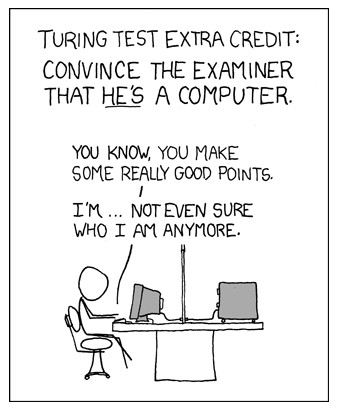
Let the Common Core assessments begin.
The SBAC assessment folks assume that the test takers won’t be under additional mental stress when using “drag and drop” procedures, or using the notepad, or locating the calculator and using it’s numbers and symbols. But our students, whom many have no computers or internet, have not developed a comfort level where there won’t be significant mental demand just operating the Chromebook. Many of our teachers also share that discomfort and are making every effort to give students more practice time with the computers.
Are the new assessments a catalyst for change in the use of technology? Absolutely. Are we ready for that change? Probably not, but it’s here, and on April 22nd and 23rd a new era of technology in education will drive it’s way into our classrooms.
Road To Teaching Conference at Santa Ana College, November 22, 2014
This post was adapted from a speech given at the Road To Teaching Conference at Santa Ana College on November 22, 2014.
When I look out at pre-service teachers, I see the future of education in California. And I feel good about it. They are bringing energy and excitement with them into the classroom. They will infuse their departments with new ideas about teaching and learning. They will understand brain theory better than any generation of teachers before them. They will use that to develop environments where students love to learn. I am very proud of the path they (and you, teachers reading this) have chosen.


 Cleaning Off The Whiteboard