Monthly Archives: March 2015
Where Are The 21st Century Skills For Rural America?
My parents’ 50th anniversary was a few weeks ago, so the entire family decided to celebrate this weekend at the farm in rural northern Florida. My nieces and nephews who live in this area are the most wonderful children that anyone could expect to have. Living in the country has taught them that hard work is a way of life. They appreciate how the wind blowing through a palm tree sounds like water flowing over a waterfall. They know the names of the plants around them. And the birds, too.
My three nieces and two nephews travel 28 miles each way to a “nearby” public school. From what I hear from them and their parents, their teachers and administrators are top notch. The work that they could not wait to show me was very high quality. It required the students to be creative and to think critically about what they were doing. I was very pleased that they were getting a high quality education.
But as I spent more time with them, I started to notice that something was lacking. These children were bright and beautiful, but not really being exposed to some very critical components of the 21st century skills set that would allow them to venture beyond the farm. Our society has deemed that these children are too far from urban areas to provide adequate internet (they still have dial-up or DSL) or even provide more than patchy cell phone service. This gap is not just affecting my nieces and nephews, but rural children all across the nation. This generation of children will find it very difficult to compete in a global economy without access to technology and acquisition of those 21st century skills such as technology and media literacy and the ability to communicate using social media.
In January, President Obama challenged Congress to address the technological needs of rural America (CNET, 2015, January 13). Much like the Rural Electrification Administration (REA) of 1935, this initiative tries to overcome the obstacles of getting high speed internet and cell phone service to rural America. This time homes are not being left in the dark, it’s the children of rural America that are being left in the dark. We can’t afford to wait for a dysfunctional government to realize the crisis already happening across our nation.

Courtesy of Vicki Feliz-Smith
I live in the city, so having high speed internet and quality cell phone service is something that I take for granted. It took a visit to the farm to realize how an entire generation of children is being denied skills to survive and thrive in the 21st century.
Getting Ready For The Common Core Assessments
After having a joke fall flat in my Algebra class, a student leaned over to me and whispered “Tell it to us again, it will be funny this time.”
But this week, at our monthly math department meeting, I presented practice problems for the second time from the Smarter Balanced Assessments. This time from the training test, a short 8-question test. From the look on my colleagues face, there was nothing funny about what they saw.
The discussions that followed were not so much about the math as they were about how our students are going to be able to understand and access the technology involved in calculating and entering a solution. With only a minimal amount of experience on the Chromebooks, would our students remember where to find the calculator? Would they understand how to group expressions with appropriate parentheses?
On April 22nd and 23rd our school will be taking the new summative (Common Core) assessment by Smarter Balanced Assessment Consortium (SBAC). We hope the joke will not be on us.
As we near the inaugural assessment, anxiousness grows among the administrators and teachers at our school and, I’m guessing, at many schools across our great state. Our school wasn’t part of the Field Test of the assessment because we didn’t have enough computer labs, nor did our technology infrastructure support mobile wireless carts. Chromebooks arrived just this year to provide roughly a 1 to 4 student-to-computer ratio. Our wireless infrastructure was updated and many teacher’s desktops were upgraded from Windows XP. We are now ready to go … or are we?
As the Common Core coordinator for my department, I took special care in making sure that our teachers new what was on the practice SBAC exams. We worked in teams and examined the 7th, 8th, and 11th grade practice exams. We discussed where our students might struggle with the mathematics, the technology, or both. I created lists of vocabulary words from the middle and high school practice tests and passed them out to the whole school. We assembled 2-inch binders with information that would help us transition. Many PLC mornings were dedicated to being prepared for the assessments.
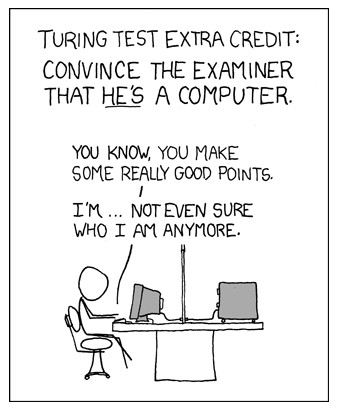
Let the Common Core assessments begin.
The SBAC assessment folks assume that the test takers won’t be under additional mental stress when using “drag and drop” procedures, or using the notepad, or locating the calculator and using it’s numbers and symbols. But our students, whom many have no computers or internet, have not developed a comfort level where there won’t be significant mental demand just operating the Chromebook. Many of our teachers also share that discomfort and are making every effort to give students more practice time with the computers.
Are the new assessments a catalyst for change in the use of technology? Absolutely. Are we ready for that change? Probably not, but it’s here, and on April 22nd and 23rd a new era of technology in education will drive it’s way into our classrooms.


 Cleaning Off The Whiteboard