Monthly Archives: April 2015
The SBAC Maiden Voyage
Today we concluded the maiden voyage of the CAASPP (SBAC) exam at our school. My hope was to monitor all aspects of the assessment (math and language arts) and report my observations and suggestions back to this blog. Unfortunately, food poisoning took hold of me the day before the math portion of the assessment and kept me away for two days. Here’s how the story unfolded.
We tested in our home rooms. The students in my home room have been with me for three years. Steven, who is now 6’4″, grew from a whopping 6’3″ as a freshman. Okay he was a tall freshman, but he looks more mature, too. Jacob, who had a young-looking face for his freshman and sophomore years, now has a full beard. Better than I could grow, too.
The thing is, I know these students, so my absence created a different atmosphere that could have had an impact on their comfort and motivation on this assessment. The other teacher that was my assistant had to take full charge of administering the exam. While both of us were trained at the same meeting, he was not prepared to be the sole administer. He is a great teacher and that made a difference in what could have been a chaotic event. Even when the wireless went out in my classroom, he smoothly moved all of the students to the pre-designated alternate room and carried on with the test.
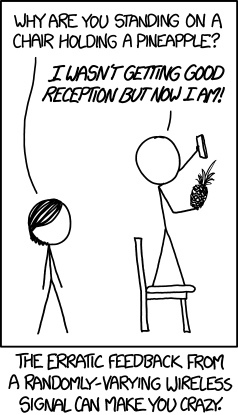
When the wireless went out during the SBAC exam.
Most students commented that the math portion of the test was easier than expected, although some confusion occurred over the use of scratch paper and several teachers did not let students use scratch paper at all. The test allowed the use of scratch paper and students commented that it would have been very difficult to solve many of the problems without scratch paper. The only other significant challenge was knowing how to use both versions of the scientific calculator on the test. The drop down version was slightly different than the version at the bottom of the screen.
The language arts portion of the exam went much more smoothly, although as an administrator I noticed several students suddenly go through 10 or 15 questions. I highly suspect that the passages that should have been read, were not.
As an inaugural assessment, I believe that it was a success. Students seemed to be engaged and comfortable with the medium used for testing. Perfection the first time around rarely happens. Now let’s wait for the results to arrive so the analysis can begin. That’s when the adjustments will really start to occur.
The Good, The Bad, and The SBAC
The Good
It’s high noon and the roll out of the SBAC online testing is tomorrow. Administrators have organized the school into areas of testing and non-testing, with our Seniors presenting their Senior Projects in the non-testing areas. Alternative classrooms have been designated in the event that wireless should fail (as it did in my wing this week). Each proctor has a assistant who has received training in conducting the exam and what drink we want from Starbucks.
The first test is the computer adaptive math test, and the allotted time for administering it is around two and a half hours. The test is untimed, so if students don’t finish in two and a half hours, well…we’ll cross that bridge when we get there. Actually, there is supposed to be a designated location where students can go and complete their tests, but that means they have to log off and log back on. Students will have to stop at a saved point to avoid re-doing problems. This move could result in a number of interesting events, but I’ll save those for the next blog.
The Bad
Day 2 is beginning to cause consternation among the faculty now that we have seen the activity that is the basis of the task questions. Most of us did not realize that half of the math portion of the assessment would be task-based.
Over 25% of Florin High School’s students are EL, with many more having been previously classified as EL. Typically our students struggle more with word-based problems and applications. Students and teachers don’t make excuses for doing poorly on those problems. There is just a steeper hill to climb to get to the answer.
A list of accepted accommodations.
The SBAC
The Smarter Balanced Assessment Consortium has established “accommodations” for English Language Learners and Students with Disabilities, but even with pre-programmed accommodations, Day 2 will be challenging for those with the EL designation and for those without it. The data collected on our students for this assessment will certainly have a significant impact on future instruction. Reading and writing across the curriculum has long been a focus, but a greater emphasis on reading mathematical material will surely emerge.
But for now, we will breathe deep, get a good night’s sleep, and be ready when Starbucks opens tomorrow. Tune in next week for the Good, the Bad, and the Ugly of the SBAC assessments.
Countdown to SBAC (or whatever it’s being called today)
While not quite as exciting as Season 5 of Game of Thrones, the saga of spotty wifi and dead batteries rampages on.
We are nearing the maiden voyage of online testing next week with some cracks beginning to appear in hull of our ship. The Math department was given an activity just a couple of days ago, and we were told that all 11th graders needed to be familiar with it in order to understand part of the Smarter Balanced Assessment. As in most places, our 11th grade students are spread over several levels of math. In order to present it to them, we either needed an emergency homeroom session (which we weren’t going to get) or every math teacher had to give up a day to teach the activity. Bribing my colleagues with my famous carnitas seemed to work, and we press on.
I have been working with many of Florin High School’s math teachers in training our 11th graders on the Smarter Balanced Assessment. First, I emailed them with links to the test prep site, the I rolled the Chromebook cart to their rooms to help get their students online. Some of the Chromebook batteries were low because they hadn’t been recharged properly. We remedied that situation easily, however. Next, I told the students to log on.
Weeks ago, I was given administrative permission to help students change their forgotten passwords, so the login process usually goes smoothly. Except today, of course.
After quickly and carefully handing out the Chromebooks to the students, one hand after another shot up. Something was wrong. Really wrong. After checking all the systems we determined that the wifi in the teacher’s room was not working. Strange. It had been working all year. So, we moved the students and their computers to my room. It always has wifi. Except today.
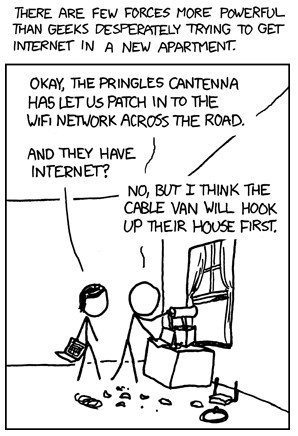
I think we can make this work for 430 students. Give me another Pringles can.
http://imgs.xkcd.com/comics/moving.png
The administrator I called seemed to not believe me. The wifi couldn’t be out in a whole wing. That wing was designated to be part of the test-administering section of classrooms. I asked if there was a reset switch for the wifi system. He didn’t know. Our tech person was offsite, so no help was coming from there. I asked what would happen if the wifi went out during the test. He wasn’t sure. Would the students be able to log back in at another location in the school? He wasn’t sure. If they pressed “save” often, would it protect them in case of a wifi outage? He wasn’t sure. I asked what the contingency plans were in case of a widespread outage. There wasn’t one… yet. Now it seemed like a good idea. You bet.
Tune in next week to see how our trusty heroes prepare for the epic online challenge. You’d better be among the first to read, or there may be spoilers (and not just from Game of Thrones!). Thank you for reading this blog. Have a great week!
The Trouble With Evaluating Technology-based Assignments
Near the end of his senior year in high school, the young man met with his principal and one of his teachers. He felt that the “B” he had received on his report card was unfair. The class was Journalism and he had done more than anyone in class. He had completed his part of the Sports section for his yearbook, finished two other parts for other students and took over for the yearbook photographer who dropped the class. The students whose sections he had completed received “A’s” in the class, but he received a “B”. When the teacher defended her actions, she told the principal that she expected more out of him than the other students.
That day nearly cost me my chance to go to college. Since then I have been very careful to ensure that my expectations are clear to my students. Rubrics are a necessity. I want to challenge all students, but as any teacher knows, some students will find your assignments more difficult than others.
Technology-based assignments are adding a whole new dimension into establishing rubrics and expectations of students. Recently, I gave an online research project to my AP Statistics classes. The criteria for the research and reporting was clearly defined in a rubric, but I left open the method of displaying the report. I gave the option of Prezi, PowToons, PowerPoint, iMovie or any other technology-based report.

PowToon Brings Awesomeness to Your Presentation
The result was a huge array of presentations, some flashy, some not. I found it very difficult to separate the expectations that I had on my rubric from the quality of the presentation. Could all of the project’s requirements be displayed in a simple Powerpoint? Yes. Did I want to give a higher score to the flashy presentations like the YouTube videos or PowToon recordings? Yes, again. But I didn’t.
My students are arranged by groups, and I knew that Group 2 would attempt a flashy presentation. The four students were very tech savvy and would find it easy to create an eye-popping presentation. Group 6, on the other hand, consisted of four students, of whom only one had internet at home. Group 6 worked on the project after school in the computer lab and the learning curve for the presentation was significantly higher for each of them.
As we progress to more technology-based lessons, teachers must be aware of the 21st century skills that our students have mastered. What part of the students’ grades is from their technological knowledge, and is that part of the rubric? Are teachers knowledgeable enough to set standards for technology-based assignments?
There is a growing number of resources that assess and support teachers in our ability to evaluate not only the content knowledge of our students, but the ability to communicate that knowledge through technology.
A couple of websites that I have found helpful are EdTechTeacher.org (http://edtechteacher.org/assessment/) and Evaluating Multimedia Presentations (http://www.learnnc.org/lp/pages/647). The EdTech Teacher site uses ISTE standards to help teachers establish rubrics for the use of technology. The Evaluating Multimedia Presentations site is a guide in establishing the role that technology-based presentations play in our assignments.
I believe that teachers must confront the reality that some students who are not digital natives will struggle with our technology-based assignments. How do we assess those who are comfortable using technology and those who are not?


 Cleaning Off The Whiteboard